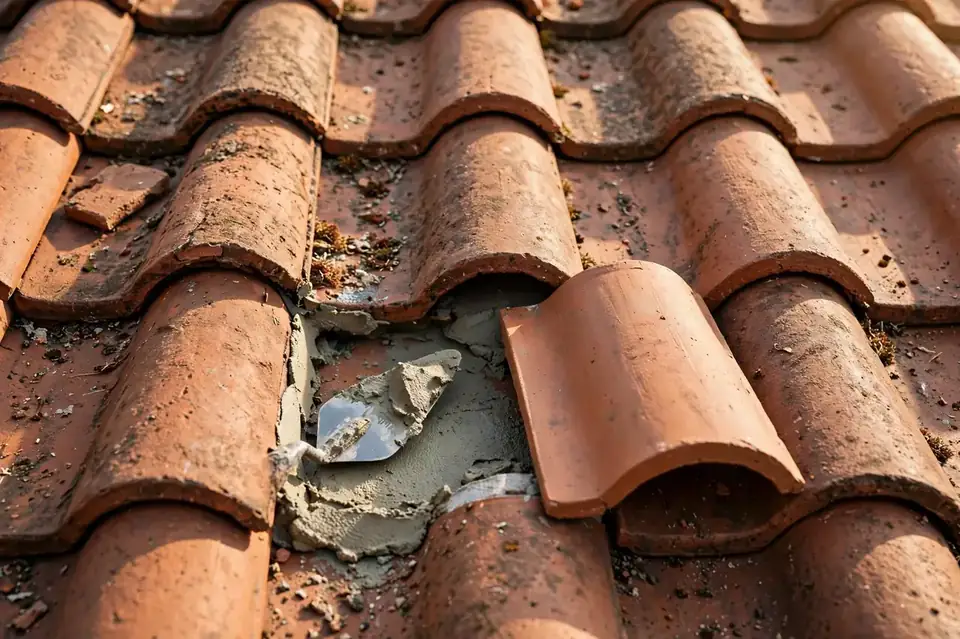
Clay tile was designed for Mediterranean winters, not New Jersey's. Freeze-thaw is tile's main enemy here — we replace cracked tiles and re-bed ridges before winter does worse.
Emergency? We answer 24/7.

Here's the thing most tile-roof owners don't realize until something goes wrong: the tiles are the armor, not the waterproofing. Clay and concrete tiles shed the bulk of rain and take the UV and impact beating, but the actual watertight layer is the underlayment beneath them — the membrane the tiles protect. A tile roof with intact tiles but failed underlayment will leak; one with a few broken tiles but sound underlayment usually won't. That split is the key to every sensible tile repair decision.
Tiles fail visibly: they crack from impact or freeze-thaw, slip when fasteners corrode, or break under foot traffic — walking tile without walk boards is one of the fastest ways to create damage. The quieter failure is the underlayment aging out beneath tiles that still look fine from the street; on many tile roofs the tiles outlive their underlayment by decades, which is why inspection always looks past the tiles.
Foot traffic is the most avoidable cause: clay and especially concrete tiles crack under concentrated weight. Any roofer on tile should use walk boards or foam pads — proposing to walk the roof directly is a warning sign about their tile experience. Impact damage from falling branches does suddenly what feet do gradually.
Freeze-thaw widens any hairline crack winter by winter until the tile splits. Fastener corrosion lets tiles slip — the tile is fine but its nail or clip has rusted away. Wind lifts poorly fastened tiles at ridges and eaves. Underneath it all, underlayment aging: heat and time break the membrane down, and once it goes the tiles above become decorative. Debris-choked valleys force water sideways under tile edges.
Every failed tile is located and marked from walk boards — plus the underlayment beneath is assessed, since tile damage and membrane damage often travel together.
Broken tiles are unhooked and lifted out; replacements matched to the existing profile are set in, without disturbing the surrounding field.
Where the membrane is compromised, it's patched or section-replaced beneath the tiles — the part of the job you never see and most need.
Valleys are cleared of debris and the custom flashing at penetrations is verified, since these are the leak points tile replacement alone won't fix.
Individual tile replacement is right when the underlayment is sound — cracked and slipped tiles are maintenance, not roof failure. But when the membrane has aged out across large areas, the honest fix is a lift and relay: tiles carefully removed, new underlayment down, original tiles back. More work than it sounds, less than a full re-roof — and a roofer should show attic-side evidence for which situation you're in before recommending either.

Clay tile is fired earth — extremely long-lived, colorfast, heavy. Concrete tile is the common modern choice: cheaper and lighter, but more porous and more vulnerable to freeze-thaw and surface erosion. Both come in profiles (flat, S-curve, barrel) — matching the existing one matters enormously for looks and water-shedding.
The practical headache is discontinued profiles: a roof tiled twenty years ago may use a shape nobody makes anymore, forcing salvage-yard sourcing that takes time and costs more. Establish availability early — it can set the whole repair timeline. Under the tiles, battens are the strips tiles hang from, and the underlayment beneath is the true waterproofing — when roofers say a tile roof is "failing," they usually mean this membrane.
Tile roofs are relatively uncommon in Secaucus, which has a practical consequence: fewer local roofers do tile work weekly, so confirm tile experience specifically — not just roofing experience — when you call. In HOA-run garden-apartment and townhome communities, visible material changes sometimes need association approval. And ask about tile availability and lead time up front rather than discovering it mid-project.
When you call (201) 330-4743, we connect you with a local roofer experienced in tile work. Photos help more than usual with tile: ground-level shots of the damage let the roofer arrive with a sense of the profile and extent. Mention the material if you know it (clay vs. concrete), the roof's approximate age, and whether anyone has walked it recently. Expect a methodical inspection — tile assessment is slow work, and rushing it misses underlayment issues or breaks more tiles.
Ask how the roof is protected during the work (walk boards or equivalent), whether replacement tiles are in stock or need sourcing, and what the underlayment looks like beneath the damage. If tiles must be ordered, that sets the schedule — the repair itself is often quick once materials arrive.
Tile and flashing are inseparable: chimney flashing repair in Secaucus on tile means custom-bent metal, so both scopes belong in one visit. Roof moss removal matters more on tile than most owners realize — moss traps moisture and speeds underlayment decay. And a full Secaucus roof assessment evaluates visible tile damage and hidden membrane condition together.
Yes — that's the normal case. Individual tiles unhook and lift out without disturbing the surrounding field, and replacements go in the same way. Spot replacement only stops making sense when the underlayment beneath has failed across large areas.
If the profile is still manufactured, very closely. If it's been discontinued, matching gets harder — salvage and specialty suppliers can often source it, but it takes longer and costs more. Establishing availability early prevents mid-project surprises.
You shouldn't. Clay and concrete tiles crack under concentrated weight, and every cracked tile is a future leak. Roofers use walk boards or foam pads that spread the load.
No — that's the most important thing to understand about tile. Tiles shed most water and protect what's beneath, but the underlayment membrane is the actual waterproof layer. Leaks on intact-looking tile roofs are almost always underlayment failures.
It varies widely with the membrane type, heat exposure, and installation quality — and it's almost always shorter than the tiles' lifespan. That's why tile roofs so often need a lift-and-relay while the tiles themselves are still perfectly good.