Drips, fogging, failed seals — most skylight problems are repaired, not replaced. Local roofers diagnose the real cause and fix it.
Emergency? We answer 24/7.

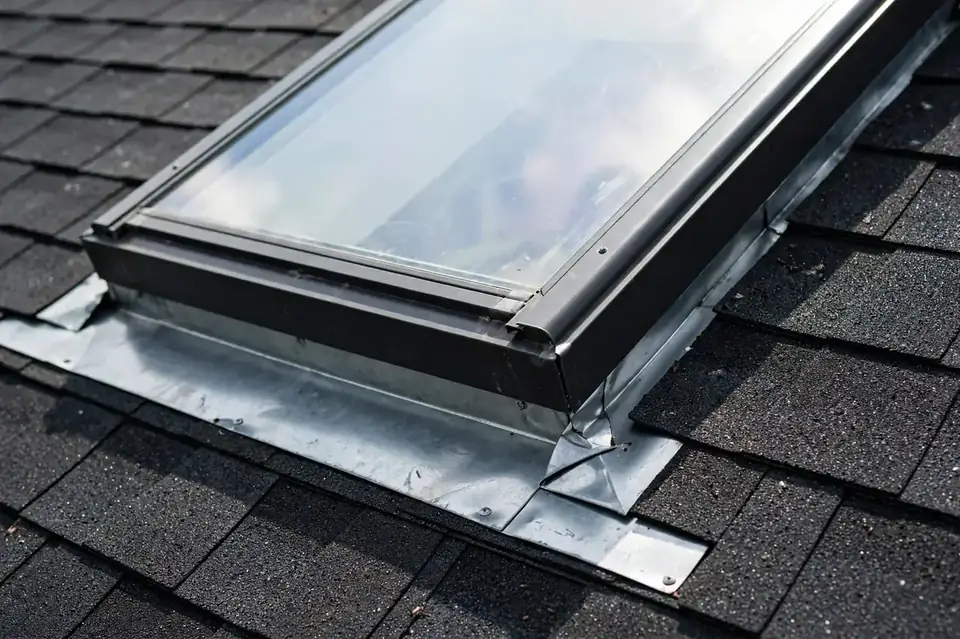
A skylight is a window installed in your roof plane, which means it lives in the harshest spot on the house: full sun, full rain, full wind, and every freeze-thaw cycle — while being expected to stay watertight like a wall window. Most skylights are one of two types. Curb-mounted units sit on a raised wooden frame (the curb) built up from the roof deck. Deck-mounted units sit lower, closer to the roof surface, with a slimmer profile. Both rely on a flashing kit — step flashing up the sides, head flashing across the top, sill flashing at the bottom — to marry the unit to the roofing.
Here's the diagnostic insight that matters: most "skylight leaks" aren't the skylight at all. Water appearing under a skylight comes from three distinct sources — failed flashing around the unit, failed seals within the unit (fogging between panes), or condensation forming on cold glass in winter and dripping like a leak. Each has a different fix and a different cost. A roofer's first job is figuring out which one you're dealing with, because replacing a skylight for a flashing problem — or flashing a skylight with failed seals — wastes your money.
Because the fix depends entirely on the diagnosis, the inspection is methodical. When we connect you with a local roofer, expect this:
The roofer determines whether you're dealing with flashing failure, seal failure, glazing damage, or condensation. This diagnosis drives everything — each problem has a different repair.
For flashing leaks, surrounding roofing is lifted and the old flashing kit is replaced with the manufacturer's proper kit — step flashing woven into the courses, new head and sill flashing, fresh sealant at the transitions.
Fogged or cracked units get replaced — the glazing assembly, not necessarily the curb or flashing if those are sound. A new unit drops into the existing curb in most cases.
The assembly is water-tested, weep holes cleared, and the interior shaft checked. The roofer confirms whether the issue was leak or condensation so you know what was actually fixed.

Describe what you're seeing and when: drips during rain, fogging between panes, stains around the shaft, or winter-only moisture. Note whether the skylight is on a flat or sloped section — it changes the diagnosis. A local roofer will inspect the flashing, the seals, and the curb, tell you whether it's a leak or condensation, and scope the fix accordingly.
Call (201) 330-4743 — 24/7. A roofer can weatherproof the unit to stop the water now and diagnose the permanent fix after.
Timing is the tell. Leaks correlate with rain — water appears during or right after precipitation. Condensation appears on cold mornings with no rain, forms evenly across the glass, and correlates with indoor humidity. A roofer confirms it by examining moisture patterns and the flashing condition.
Both are common, and the diagnosis decides. Flashing leaks are repaired with a new flashing kit while keeping the unit. Fogged glass (failed seals) or cracked glazing means the glazing assembly must be replaced — though the curb and often the flashing can stay.
No. Fogging between panes means the perimeter seal has failed and moist air is trapped inside. It won't dry out on its own, and there's no repair for the seal — the glazing assembly needs replacement.
In most cases, yes — the glazing assembly (glass plus its frame) is replaced as a unit and drops into the existing curb. A full tear-out including the curb is only needed if the curb is rotted or undersized.
Whether it's a flashing repair or a unit replacement, the skylight's size and type (fixed versus vented), roof pitch and access, curb condition, any interior shaft damage, and how many skylights need work. The diagnosis has to come first.
Not necessarily — but it's worth having the others inspected while the roofer is there. Skylights installed at the same time age together, and the marginal cost of addressing a second marginal unit during the same visit is lower than a separate trip later.
Most skylights repaired same-visit — no replacement upsell.
Call (201) 330-4743